|
For the past twelve years, I’ve sent kiddos off to school. It has been a mixed blessing; there is part of me that is ecstatic to have the school routine back! AHHHHH…for 35 hours each week, my children are engaged and I can put away my cruise director hat for nine blissful months.
Then, I quickly remember that when the cruise director hat is on the shelf, the advocate hat may have to be dusted off! It makes me wonder how our kiddos feel when they go back to school? Anxious? Stressed? Excited? Confused? Sad? For many of our kiddos, these emotions present the same! They may engage in dysregulated behavior, have increased self-stimulatory or self-injurious behavior, may have more frequent outbursts and regressed sleep issues, just to name a few. As parents (and advocates!), there is much we can do to prepare our kiddos for this transition. We can also prepare teachers and professionals to know our children before they ever walk through the front door! Mostly, we can choose to be grateful for IDEA (Individuals with Disabilities Education Act) which allows our children to attend school and have support! Here are a few ideas to consider which may set the occasion for a successful back to school transition! ✅ A visual monthly calendar with home and school icons can show our students when school is going to start! This visual tool can be used throughout the year to communicate to our students when school is out (including weekends and holidays). ✅ Create an “All About Me” profile about your student to share with the teacher and other professionals. Update it at the end of the summer and include things like the student’s likes/dislikes, things that might make the student happy or upset and important things for the teacher or professional to know! ✅ For students with executive functioning and organizational difficulties, consider color coding academics and aligning the colors by binders, notebooks and folders. For example, green is for science; create a green binder, green spiral notebook and green folder so the student can quickly grab the correct supplies needed for the class! We used green for science, blue for history, black for comm arts/ELA, red for math, etc. We started this in sixth grade and my son (attending college this fall!) still uses this same color system to this day! ✅ Start the year off positively with the teacher (both special ed and each regular education teacher). A small gift and a thank you note in advance of the year speaks volumes to your grateful heart for their hard work! ✅ Advocate for needs in person or over the phone; avoid email! Your care and concern comes through so much more through face-to-face/phone interactions and can get lost in the written text. Remember to avoid “why” questions which can evoke defensiveness from the listener! ✅ You are not alone! There are advocacy options to assist you if you are struggling with IEP or school-related issues. Consider Wisconsin FACETS, Wisconsin Coalition for Advocacy, Disability Rights Wisconsin and CESA. Finally, take a deep breath and commit to a great year! You got this!
0 Comments
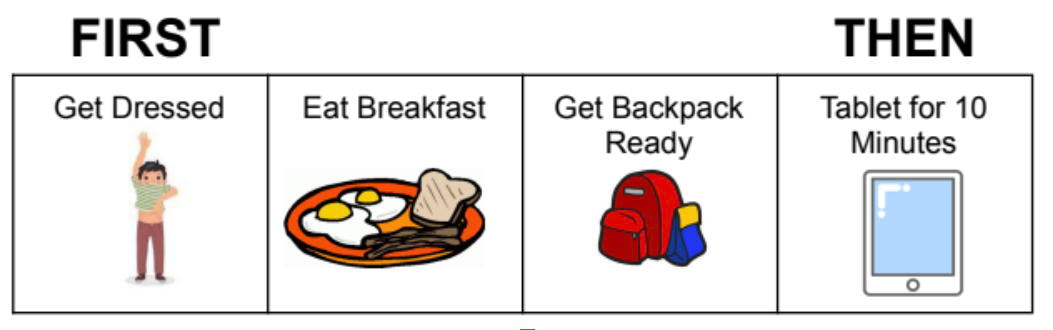
Close your eyes and picture all of the things that you have done today so far. Now picture all of the things that you have to do. Some of these things might be very routine, where you can almost complete them with your eyes closed (although this is not recommended). Some of these tasks are less routine than others, and you need a bit more support to understand what needs to be done and in what order. You may even need some instruction on how to do a task. Luckily, we have access to step-by-step instructions, online tutorials, and friends and family to reach out to! Having a visual reminder or prompt of the ins and outs of your daily tasks and routines can be tremendously useful, helping you stay organized and feel in control. Now picture your loved one and all of the things they must accomplish on a daily basis. Think of the things that they can do independently, from start to finish. Think of the tasks during which you may need to provide more support. What does your support look like? Are you giving verbal reminders? Do you provide hand-over-hand assistance? Do you point to the next step? Maybe you feel like you just need to get your loved one from point A to point B in a timely manner and don’t feel like there is enough time in the day to allow for teaching independence with certain routines. No doubt, this can all be very overwhelming and frustrating for you and your loved one. A visual schedule can not only show your loved one what they need to do to complete a task, it can also help them understand a clear beginning, middle, and end to a daily routine. Having an understanding of when the less preferred tasks will be done and when something more preferred will happen can reduce anxiety and increase task “buy in.” Furthermore, a visual schedule can offer guidance without reliance on verbal or physical cues from others, thus setting the tone for greater independence.
A visual schedule can be individualized to meet your loved ones needs and abilities. It may be electronic (there’s an app for that), a written list, include pictures or photos, change according to the task at hand, or outline a set order of events. It can include moveable icons, places to put icons when the task is done, allow for flexibility and choices… the options are endless!
Through Unpaid Caregiver Training Services, FIS can help provide guidance and support on determining where and how to start with teaching your loved one how to live more independently, transition from task to task more smoothly, and celebrate the momentum that builds through accomplishment. Sustainable strategies like visual schedules are just one of the many tools that can help your loved one conquer a task and move on to what’s next! We often hear phrases such as, “I can’t go to the store or Johnny will run off, “ or “We can’t go to church together because they aren’t sure what to do when Sally starts hitting her head.”
Problem behavior is an ongoing struggle for most participants with disabilities. We know that all behavior is communication and so often, parents and other professionals struggle with figuring out exactly WHAT the participant is trying to communicate. A behavior support plan may be part of the solution! Behavior support plans (a “BSP”) start with an assessment of the individual’s needs, focusing on events (both internal and external) in the environment that may “trigger” problem behavior. After speaking with caregivers and other collaborative professionals (e.g., school staff), completing observations, and gaining an understanding of what is contributing to the problem behavior, we work with caregivers to create a plan that focuses primarily on two things: 1) developing proactive and reactive strategies that can help decrease the problem behavior, and 2) creating “replacement behavior” strategies that caregivers can systematically teach the individual so that the problem behavior no longer needs to occur in order to get needs met. Sounds great, doesn’t it? But this process takes TIME! Many participants have been through support plans, intensive ABA and other therapies. They may be in fight, freeze or flight mode and very resistant to intervention. A general rule of thumb is that for every year a problem behavior has been occurring, it may take at least a month to start seeing positive changes once the BSP is being used consistently. Here’s the really good news - caregivers are not in this alone! The FIS team pairs with caregivers to help them learn the skills necessary to implement the BSP recommendations, working through difficult situations and making changes to the plan when necessary. FIS behavior analysts work with caregivers to understand whether the plan is making a positive change or not (through collecting high quality, low effort data) and fading support over time as determined by the individual’s success. FIS believes a full and active life is supported by nurturing caregiver relationships that help reduce the occurrence of problem behavior. The BSPs that we develop with caregivers are always research-based, always positive, and always designed with an eye towards promoting optimal community integration. Effective BSPs are individually designed, emphasize the acquisition of new skills, promote community/social integration, are culturally responsive, and include making changes to the environment as needed. We look forward to partnering with you for positive behavior change! In life, we have those people around us that provide support without being paid to do so; sometimes they are referred to as “natural supports”. The more obvious unpaid caregivers include parents, grandparents, and family members. The less obvious include family friends, neighbors, church and social group members, and even co-workers.
When it comes to those with disabilities, unpaid caregivers often bear the responsibility of not only ensuring the safety of these individuals, but also fostering growth and assisting them to live their best, most independent life. Overwhelming? Yes! Can it be accomplished? Absolutely! At Forward, we provide unique training for the trainer. We have a distinct approach of knowing how to train you and other caregivers virtually to make the process as easy for you as possible. Through a tailored and systematic approach, we guide unpaid caregivers through various topics and teach them how to walk through disability support and caregiving with confidence. Topics may include (but are definitely not limited to!):
And the list goes on and on… With Forward Integrated Services, you tell us what would be most helpful to learn and we’ll go from there. Regardless of the topic, there is a great sense of empowerment that accompanies the phrase, “I got this!” We would be honored to have the opportunity to help get you there – one skill at a time! Regrettably, I’ve kind of been stumped with this question when asked by community members so I don’t blame you for asking! No doubt in this situation, it’s easier to do the service than describe the service.
Insurance denials, recruiting staff, finding curriculum and resources, strollers and handicapped stickers, solutions for sibling support, identifying mental health and other speciality providers, researching recreational and social opportunities, connect with community resources such as DVR…these are all examples of a day in the life of a community integration specialist. So, here’s the quick way to figure it out for yourself– Stop and ask yourself: Are you or your participant struggling with navigating successful community engagement? For example, do you avoid going out or taking your participant into the community because it’s simply too difficult or people don’t understand how to interact with him/her? Perhaps you worry about what might happen should a meltdown occur and need assistance to make a plan for a crisis event? Are you overwhelmed with all of the daily details required to successfully engage your participant or acquire the resources he/she needs? Are you or your participant at risk of having to leave the home (even temporarily) either now or in the future due to problem behavior or mental health issues? Are you or your participant overwhelmed with finding the right resources in the community and need someone to come alongside you as a “resource GPS”? If you have answered yes to any of these questions or you read the examples and you think, “I NEED THAT!,” you and/or your participant may be best served with community integration services! Our CIS specialists come alongside you to find and research resources, develop crisis plans to share with relevant stakeholders, identify options which could allow the participant to successfully integrate within their community (e.g., local community, church community, volunteer community, employment options, etc.) and support other goals outlined by you and/or your service coordinator. There is simply no need to spend precious time researching options to support yourself and your loved one; let us come alongside you to clear the path of some speed bumps to allow for a smoother journey. Do you get tired of making so many phone calls to find the right resources? As a mom of two sons on the Autism spectrum and a caregiving daughter to a father with dementia, I often wish I could call one place and have a majority of my needs met or perhaps I could find someone who could help me navigate the life GPS that's required to survive each day.
At Forward Integrated Services, we partner with clients and families to provide seamless transitions and life navigation on this journey from womb to the tomb. Supporting persons with disabilities can be overwhelming but the load can be lightened if you have the right partners on the journey. Services like Unpaid Caregiver Training can assist you in creating digital training and communication materials so you don't have to repeat yourself each time you hire a new worker or talk to a new provider. Community Integration Services provide a service partnership and problem solving to increase positive community involvement and reduce residual stress for parents. But what if my child is a flight risk or can't attend a function due to problem behavior? Then perhaps Behavior Support or Safety Planning and Prevention are needed services to increase the likelihood of community success. Our Social Skills class teaches the skills necessary to "hang out" and socialize with same-aged peers. So often my sons haven't socialized due to the anxiety of not knowing how to do so successfully. We want to come alongside to assist you and yours as you navigate these hurdles. We hope you will find our team of empathic yet goal-driven behavior analytic specialists the long-needed, one-stop option for your family. We care. We commit. We collaborate. Most of all, we look forward to partnering with you. |
AuthorWrite something about yourself. No need to be fancy, just an overview. Archives
September 2023
Categories |

 RSS Feed